Shure SM7B Gain Staging: Best Audio Interface & Preamp Settings (2026)
The Shure SM7B is indisputably the most recognized broadcast microphone in digital media. From multi-million dollar podcast studios to solo YouTube workstations, its iconic matte-black silhouette, internal air suspension shock mount, and exceptional off-axis room noise rejection have made it the gold standard vocal transducer. Yet, thousands of creators unbox an SM7B, plug it into an entry-level audio interface, crank the gain knob to 100%, and are horrified by the result: an extremely quiet vocal signal buried beneath an overwhelming wall of analog hiss and static.
For nearly a decade, internet forums and creator tutorials repeated a single dogmatic piece of advice: “You cannot use an SM7B without buying a $150 Cloudlifter CL-1 or FetHead.” In 2026, this advice is largely outdated. Advances in operational amplifier design, ultra-low-noise discrete preamps, and 32-bit digital signal architecture have fundamentally shifted the economics of dynamic microphone amplification. In this comprehensive technical guide, we break down the physics of dynamic cartridge sensitivity, explain Equivalent Input Noise (EIN), provide exact gain staging numbers for OBS and DAWs, and benchmark the best modern audio interfaces capable of powering the SM7B natively.
Key Takeaways: The SM7B Gain Staging Rulebook
- Low Sensitivity is a Feature, Not a Defect: The Shure SM7B has an output sensitivity of -59 dBV/Pa (1.12 mV). Its thick diaphragm and passive electromagnetic humbucking coil reject keyboard clatter and HVAC rumble, but require +55 dB to +65 dB of clean analog gain.
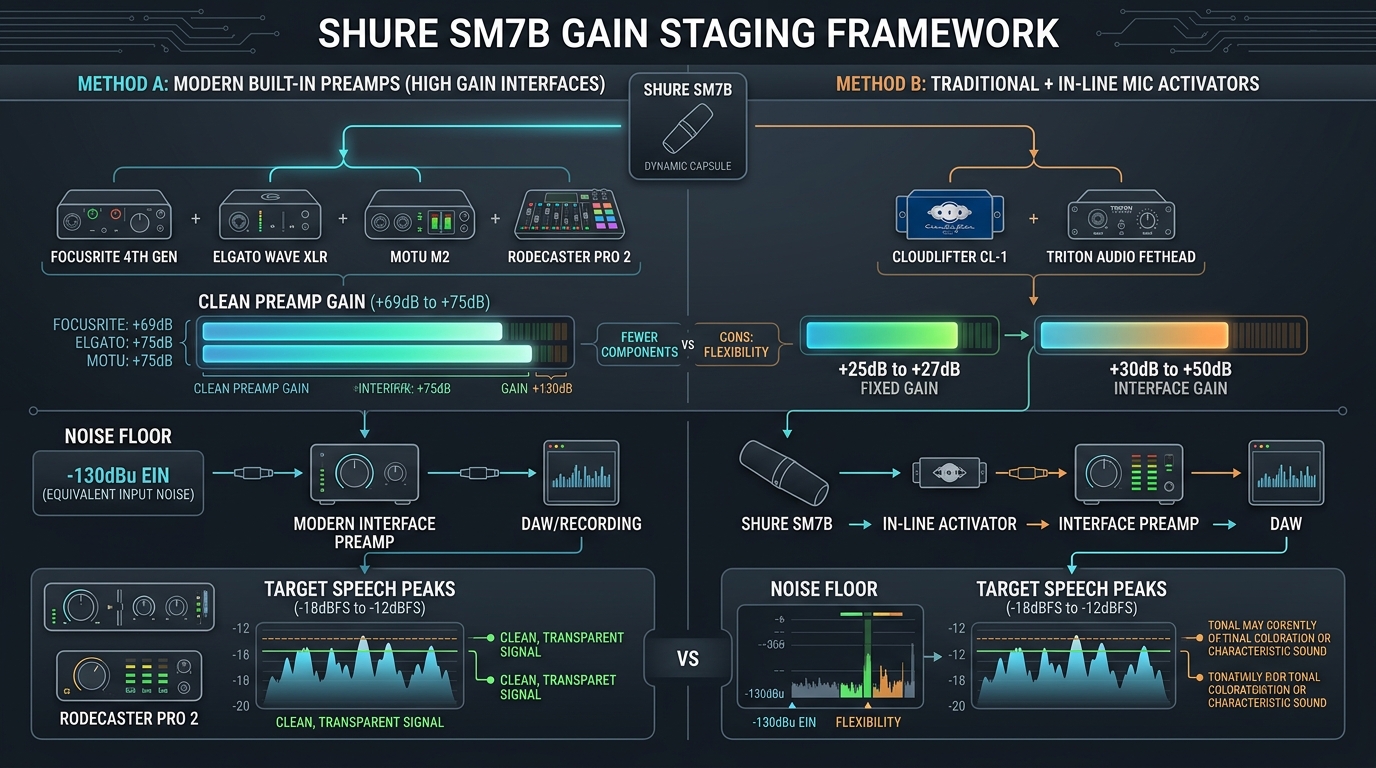
- The Cloudlifter is No Longer Mandatory: Modern 4th-generation and professional USB audio interfaces now provide +69 dB to +76 dB of ultra-clean gain with an EIN rating of -129 dBu to -131 dBu, rendering in-line booster preamps completely unnecessary.
- Target Digital Speech Levels: Aim for conversational speech to average around -18 dBFS to -14 dBFS (RMS), with transient vocal excitement peaking between -10 dBFS and -6 dBFS. Leaving 6 dB of digital headroom prevents digital clipping.
- Hardware Gain First, Digital Gain Second: Always maximize clean analog preamp amplification before applying software digital makeup gain in OBS or your digital audio workstation (DAW). Digital amplification multiplies the analog noise floor.
- Impedance Matching Matters: The SM7B has a nominal output impedance of 150 ohms. Connecting it to an interface with an input impedance of at least 1,500 ohms (a 1:10 bridging ratio) ensures linear frequency response and full bass extension.
The Physics of Dynamic Microphones: Why the SM7B Demands So Much Gain
To understand gain staging, you must understand how the SM7B converts sound waves into electrical voltages. Unlike condenser microphones that utilize an ultra-thin gold-sputtered Mylar membrane charged by +48V phantom power, the Shure SM7B is a purely passive dynamic microphone based on electromagnetic induction.
Inside the Unidyne III cartridge sits a heavy copper voice coil attached to a reinforced diaphragm, suspended within the magnetic field of a permanent magnet. When acoustic sound pressure hits the diaphragm, the coil moves across the magnetic field, generating a minute electrical signal measured in millivolts.
| Microphone Model | Transducer Type | Sensitivity (1 kHz at 94 dB SPL) | Gain Required for Speech |
|---|---|---|---|
| Rode NT1 (5th Gen) | Large Diaphragm Condenser | -32.0 dBV/Pa (25 mV) | +25 dB to +35 dB |
| Shure SM58 | Handheld Dynamic | -54.5 dBV/Pa (1.85 mV) | +45 dB to +52 dB |
| Shure SM7B | Studio Broadcast Dynamic | -59.0 dBV/Pa (1.12 mV) | +58 dB to +65 dB |
| Electro-Voice RE20 | Broadcast Variable-D Dynamic | -56.5 dBV/Pa (1.5 mV) | +52 dB to +58 dB |
Because the SM7B outputs a signal that is roughly 27 decibels weaker than a standard studio condenser, your audio interface’s preamp must perform massive mathematical amplification. If your preamp only offers +50 dB of maximum gain, you will be forced to max out the knob, driving the operational amplifier into its distortion ceiling where thermal electronic noise (hiss) dominates the frequency spectrum.
The Preamp Metric That Actually Matters: Equivalent Input Noise (EIN)
Many creators mistakenly believe that raw decibels of gain are all that matter. In reality, the critical metric determining whether your SM7B sounds broadcast-clean or like a rushing waterfall of static is Equivalent Input Noise (EIN).
EIN measures the inherent thermal noise generated by the electronics of the preamp itself when terminated with a 150-ohm resistor (matching the SM7B’s output impedance). In theoretical physics, the lowest possible thermal noise floor at room temperature (Johnson–Nyquist noise) across the human audible spectrum (20 Hz to 20 kHz) is -130.8 dBu.
- Poor Preamp Quality: EIN of -120 dBu to -124 dBu. When amplifying an SM7B by +60 dB, audible white noise will plague your podcast or YouTube voiceover.
- Acceptable Quality: EIN of -125 dBu to -127 dBu. Acceptable for loud vocalists, but soft conversational speaking will exhibit faint hiss in silent pauses.
- Broadcast Studio Quality: EIN of -128 dBu to -131 dBu. Virtually indistinguishable from the theoretical physical limit. Delivers pitch-black backgrounds even at +62 dB of amplification.
The Cloudlifter Dilemma: Do You Really Need One in 2026?
In 2018, the best-selling audio interfaces on the consumer market (such as the Focusrite Scarlett 2nd Gen) had maximum gain ranges capped at +50 dB or +56 dB, with EIN ratings around -125 dBu. Connecting an SM7B directly to those units was disastrous. Users turned to the Cloud Microphones Cloudlifter CL-1 or Triton Audio FetHead—passive, JFET-powered in-line preamps that use phantom power (+48V) to inject a clean, fixed +25 dB boost before reaching the interface.
When an In-Line Activator is Useful:
- You already own an older legacy interface (Focusrite 2i2 Gen 1/2/3, Behringer UMC22, PreSonus AudioBox) with less than +56 dB of gain and don’t want to replace your hardware.
- You are running an extraordinarily long XLR cable run (50+ feet) through an electrically noisy environment and need to boost the signal before transmission.
When an In-Line Activator is a Complete Waste of Money:
- You are purchasing a modern interface released in the last 3 years with built-in high-gain discrete preamps.
- You own an interface like the Focusrite Scarlett 4th Gen (+69 dB gain), Elgato Wave XLR (+75 dB gain), or Rodecaster Pro II (+76 dB gain). Adding a Cloudlifter to these devices inserts redundant circuitry, extra XLR cable failure points, and offers zero acoustic noise improvement.
Best Modern Audio Interfaces for Shure SM7B (2026 Benchmarks)
If you are setting up an SM7B studio today, the following hardware interfaces provide pristine, noiseless native gain without requiring an in-line booster:
| Audio Interface | Max Preamp Gain | EIN Rating | Cloudlifter Needed? |
|---|---|---|---|
| Elgato Wave XLR | +75 dB | -130 dBu | No (Native Powerhouse) |
| Focusrite Scarlett 2i2 (4th Gen) | +69 dB | -127 dBu | No (Auto-Gain Built-In) |
| Rode Rodecaster Pro II / Duo | +76 dB (Revolution) | -131.5 dBu | No (Studio Benchmark) |
| MOTU M2 / M4 | +60 dB | -129 dBu | No (Pristine ESS Sabre DAC) |
| Audient iD14 Mk II | +58 dB | -129 dBu | Borderline (Good for loud speech) |
| Universal Audio Volt 1 / 2 | +55 dB | -126 dBu | Recommended for soft spoken |
Step-by-Step Gain Staging Protocol for the Shure SM7B
Proper gain staging is the practice of managing signal levels across every component in your signal chain—from physical microphone placement to analog preamplification, audio interfaces, and digital recording software. Follow this exact 5-step checklist:
Step 1: Physical Microphone Technique (Proximity Effect)
Because the SM7B is an insensitive dynamic microphone, distance is your enemy. The inverse-square law dictates that doubling your distance from the capsule quarters the acoustic sound energy reaching the diaphragm.
- Distance: Position your mouth between 2 and 4 inches (5 to 10 cm) from the windscreen.
- Angle: Speak slightly off-axis (aimed towards your cheek rather than straight down your throat) to eliminate plosive pops (“P” and “B” air blasts) without sacrificing low-end warmth.
- Switches on the Back: The SM7B features two hardware switches on the rear plate: Bass Roll-Off and Presence Boost. For typical broadcast voiceover, leave the Bass switch Flat and activate the Presence Boost switch. This adds a subtle +3 dB shelf around 4 kHz to 8 kHz, adding vocal air and articulation that naturally cuts through background music.
Step 2: Dialing In Analog Interface Preamp Gain
- Open your recording software (OBS Studio, DaVinci Resolve Fairlight, Audacity, or Adobe Audition) and view the input meter.
- Sit in your natural recording posture and speak at your normal conversational cadence. Do not whisper or shout.
- Slowly raise the analog gain knob on your interface until your speech consistently bounces between -18 dBFS and -14 dBFS (RMS) on the digital meter.
- Now, deliver an energetic, loud line (as if laughing or reacting). Ensure the transient peaks do not exceed -6 dBFS.
- Under no circumstances should the meter ever hit 0 dBFS. Digital clipping (flat-topped square waves) occurs instantly at 0 dBFS and cannot be repaired in post-production.
Step 3: Managing the Digital Signal Chain in OBS Studio
Once your hardware preamp is sending a clean, unclipped -18 dBFS signal into Windows, configure your digital filter chain in OBS. In OBS Studio’s Audio Mixer, click the three dots next to your mic and select Filters. The order of filters is paramount:
| Filter Order | Filter Type | Recommended Parameter Setting |
|---|---|---|
| 1. Noise Gate / Suppression | RNNoise (AI Based) | Eliminates room tone and PC fan hum during vocal pauses. |
| 2. Equalizer (3-Band / Parametric) | High-Pass Filter | High-pass at 80 Hz (12 dB/oct) to clear sub-audible table thumps; gentle dip at 400 Hz for boxiness. |
| 3. Compressor | Dynamic Leveler | Ratio: 3:1 | Threshold: -16 dB | Attack: 5 ms | Release: 60 ms | Output Gain: +3 dB. |
| 4. Limiter | Brickwall Peak Ceiling | Threshold: -1.5 dB | Release: 60 ms. Prevents unexpected screams or laughter from ever clipping 0 dBFS. |
Frequently Asked Questions (FAQ)
Can phantom power (+48V) damage my Shure SM7B?
No. Standard +48V phantom power will not damage a modern, properly wired Shure SM7B dynamic microphone. Because the SM7B is transformer-balanced and wired according to modern XLR pin standards (Pin 1 ground, Pin 2 positive, Pin 3 negative), equal voltage is applied across Pins 2 and 3 with no potential difference across the dynamic coil. However, always turn off phantom power before plugging in or unplugging an XLR cable to avoid loud electrical pops.
What is the difference between the Shure SM7B and the Shure SM7dB?
Released by Shure in late 2023, the Shure SM7dB features the exact same acoustic cartridge and internal components as the classic SM7B, but integrates a built-in preamplifier licensed directly from technology similar to Cloudlifter. By engaging a switch on the rear of the SM7dB and supplying +48V phantom power, you get an onboard clean boost of +18 dB or +28 dB, making it compatible with any entry-level audio interface. If you already own an interface with +70 dB gain, the original SM7B remains the better monetary value.
Why does my Shure SM7B pick up so much room echo if it’s dynamic?
While dynamic microphones reject distant sound better than condensers due to lower transient sensitivity, they are not magical soundproofing shields. If you record in a room with bare drywall, hardwood floors, and glass windows, sound waves will bounce off surfaces and enter the front of the capsule alongside your direct voice. Move closer to the microphone (within 2-3 inches), lower your preamp gain slightly, and hang heavy blankets or acoustic absorption panels behind your head to absorb vocal reflections.
Is the Focusrite Scarlett Solo 3rd Gen good enough for the SM7B?
The Scarlett Solo (3rd Gen) provides +56 dB of maximum gain. While you can technically record speech with the gain knob turned to 95%, you will experience a noticeable baseline hiss during quiet sections, and you will have virtually zero headroom if you speak quietly. If using a 3rd Gen Scarlett with an SM7B, adding an in-line booster like a FetHead or Cloudlifter is highly recommended. By contrast, the newer 4th Gen Scarlett offers +69 dB and handles the SM7B natively.
What should my final YouTube audio loudness be (LUFS target)?
YouTube’s playback normalization system targets -14 LUFS integrated. If your video is louder than -14 LUFS, YouTube will automatically turn it down (visible in “Stats for Nerds” as a volume percentage). If your video is quieter than -14 LUFS, YouTube will leave it quiet, making your content hard to hear on mobile devices. Master your final YouTube video so vocal dialogue sits between -15 LUFS and -14 LUFS with true peaks never exceeding -1.0 dBTP.