Facial Expression Psychology in Thumbnails: Curiosity vs Excitement (2026)
Between 2018 and 2022, a universal visual trope dominated YouTube: the exaggerated, wide-mouthed, hands-on-cheeks “YouTube O-Face.” Influenced by viral creators, every channel—from Minecraft gamers to financial analysts—plastered screaming, cartoonish expressions across their thumbnails to shock viewers into clicking. But in 2026, audience psychology has dramatically matured. Viewers experience severe “clickbait fatigue” and visual desensitization; today, hyperbolic screaming faces often trigger immediate skepticism and high bounce rates.
Top-performing creator studios have pivoted to nuanced facial micro-expressions grounded in cognitive psychology and evolutionary biology. Instead of theatrical cartoon hysteria, modern high-converting thumbnails leverage subtle cues of intense curiosity, quiet disbelief, authentic skepticism, and focused intrigue. Understanding how the human brain processes emotional facial signals allows you to create authentic emotional resonance that drives high initial CTR while maintaining superior audience retention. In this guide, we break down facial expression science, eye gaze vectoring, and the exact expressions that win on modern YouTube.
Key Takeaways: The Facial Expression Science
- The Death of the “O-Face”: Empirical YouTube Studio A/B testing reveals that wide-open mouth screaming faces experience an average 14% lower watch time share in 2026 compared to closed-mouth, subtle expressions of intrigue and determination.
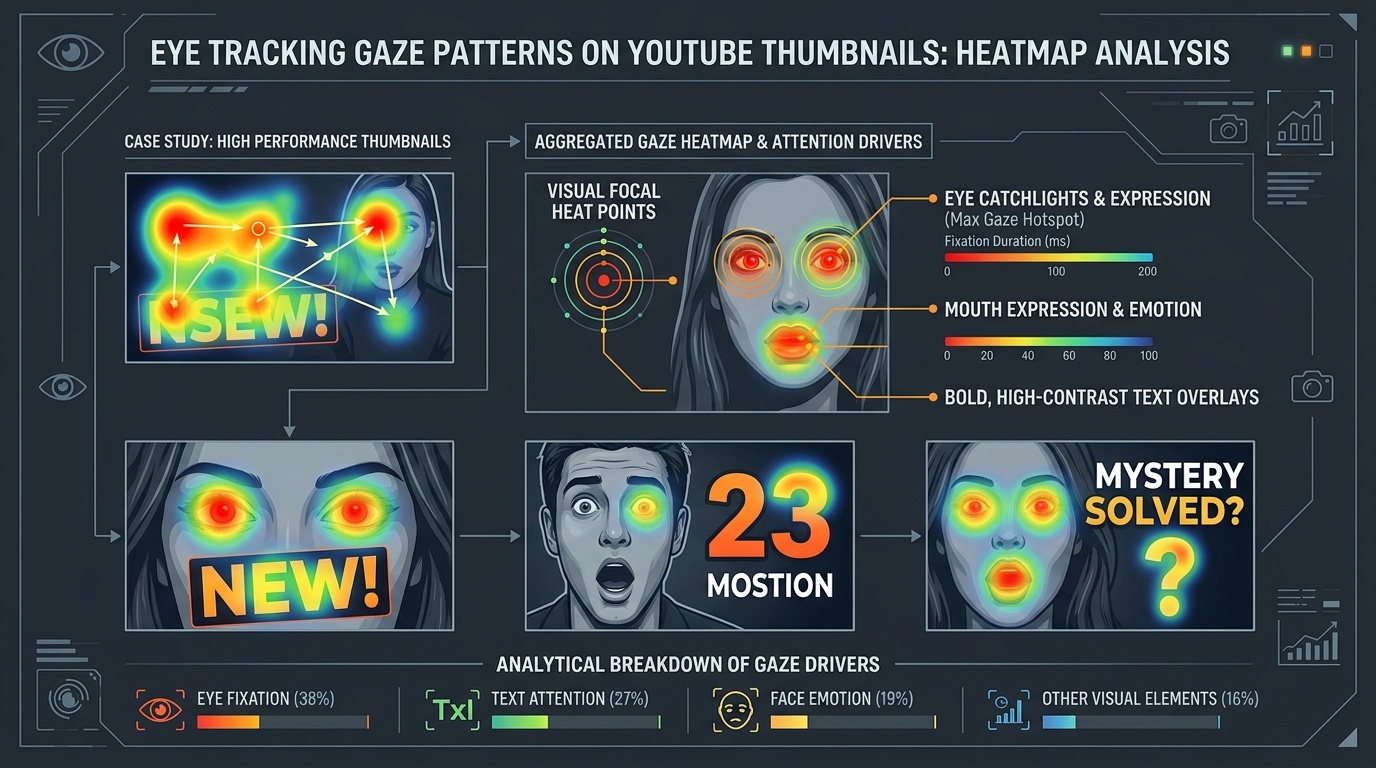
- The Fusiform Face Area (FFA): The human brain possesses a dedicated neural network (the FFA) designed to identify, interpret, and mirror human faces in less than 100 milliseconds. An authentic facial expression is processed faster than any word of text.
- Curiosity Trumps Hype: Expressions of restrained skepticism (raised single eyebrow, slight smirk, head tilt) stimulate the brain’s information-gap curiosity loop, compelling the viewer to click to resolve the visual tension.
- Directional Gaze Vectors: Never have your eyes look aimlessly into empty canvas space. Looking directly into the camera lens establishes human connection; looking intently toward an object or text hook forces the viewer’s gaze to follow.
- Micro-Contrast in Eyes and Teeth: Dodging the whites of the eyes (sclera) and enhancing iris color saturation by 10% to 15% in post-production increases perceived expressiveness at smartphone thumbnail scale.
The Evolutionary Biology of Facial Scanning
Humans are inherently social primates. Millions of years of natural selection have optimized our visual cortex to detect emotional intent from fellow humans instantly. When a viewer scrolls through a wall of algorithmic recommendations, their eyes automatically bypass abstract geometric graphics and lock onto human eyes and facial contours.
This biological mechanism is governed by two psychological phenomena:
- Emotional Contagion: When a viewer observes a specific facial expression, their mirror neurons fire, causing them to subconsciously experience a faint echo of that same emotion. If the face looks genuinely intrigued, the viewer feels curious; if the face looks like a fake stock photo actor, the viewer feels manipulated.
- Social Referencing: When humans encounter unfamiliar or complex information, they look at another person’s reaction to judge whether the situation represents danger, opportunity, humor, or absurdity. Your thumbnail face serves as the emotional benchmark for the video’s premise.
Curiosity vs. Excitement: When to Use Each
Not all videos require the same emotional temperature. Aligning the wrong emotional expression with your video concept creates dissonance that depresses click velocity:
| Emotional Category | Facial Anatomy / Micro-Cues | Psychological Driver | Ideal Video Niches |
|---|---|---|---|
| Intense Curiosity | Slight brow furrow, head tilted 10°, eyes narrowed in sharp focus, lips lightly closed or pressed. | Information gap, intellectual intrigue, puzzle solving. | Tech reviews, science documentaries, investigative journalism, case studies. |
| Skepticism / Disbelief | One eyebrow arched higher, subtle smirk on one side of mouth, chin slightly retracted. | Contrarian debate, myth busting, exposing scams or hype. | Finance, software comparison, fitness myths, political commentary. |
| Pure Delight / Breakthrough | Genuine Duchenne smile (crinkles around outer corners of eyes), relaxed jaw, bright forward gaze. | Aspiration, mastery, triumph over difficulty. | Creative software wins, speedruns, fitness transformations, travel vlogs. |
| Hyperbolic Excitement (Avoid) | Wide unblinking eyes, mouth stretched open in fake scream, hands on temples. | Sensationalism (often perceived as low-effort spam). | Kids content only; actively repels adult educational audiences. |
The 3 Eye-Gaze Strategies That Direct Viewer Action
The eyes are the focal anchor of any portrait thumbnail. How you position the subject’s pupils dictates how the viewer navigates the rest of your composition:
1. The Lens Lock (Frontal Direct Gaze)
The subject looks directly down the barrel of the camera lens, making unbroken eye contact with the viewer. This creates high psychological accountability and empathy. Use this when the video title is a personal statement, strong opinion, or direct advice (e.g., “I was wrong about this” or “Why you must quit your job”).
2. The Lateral Look-Across (The Curiosity Vector)
Position the subject on the right third of the frame, but have their eyes glance sharply toward the left third where a product, graphic diagram, or text hook is located. Viewers will look at the face first, notice the direction of their gaze, and immediately travel along that vector to inspect the object. This is the single highest-converting layout for product reviews and unboxings.
3. The Downward Look (The Specimen Inspection)
The subject looks downward at their hands or a desk surface where an object is being held or manipulated. This signals intense concentration and craft, making it ideal for tutorials, woodworking, coding breakdowns, and miniature painting.
Retouching Facial Features for Mobile Thumbnail Scale
A photograph that looks stunning at full 4K resolution can turn into a muddy, unrecognizable blob when shrunk to 1.5 inches on a mobile screen. Professional thumbnail artists apply targeted retouching to preserve facial clarity:
- Eye Whitening (Sclera Dodge): In Photoshop, use a soft brush on a Curves or Exposure layer to gently brighten the sclera (white area of the eyes) by +0.5 to +1.0 stops. Do not make it pure unnatural white; preserve natural blood vessel texture while removing dull gray shadows.
- Iris Saturation & Sharpening: Select the colored iris of the eye and apply a High Pass filter (radius 1.5px) paired with a 15% saturation boost. This gives the eyes a lifelike “spark” that remains visible on smartphone screens.
- Catchlight Enhancement: Ensure there is a crisp white reflection (catchlight) in the upper quadrant of the pupils. Eyes without catchlights look dull, lifeless, and psychologically detached (“dead eyes”).
- Midtone Face Dodge: Faces in natural lighting often feature deep shadows under the eyebrows, nose, and chin. Paint a soft warming dodge (Curves set to Screen at 20% opacity) into these shadow crevices to keep the facial structure open and readable.
- Subtle Rim Light: Add a 2px to 3px colored or white edge light around the hair and jawline to prevent the subject’s head from blending into dark backgrounds.
Ethical Facial Packaging: Preserving Creator Trust
While psychological framing is essential for competing in a crowded recommendation feed, always maintain alignment between the emotion portrayed on the thumbnail and the actual emotional tone of the video. If your thumbnail shows the creator looking devastated in tears, but the video is a lighthearted 10-minute vlog about buying a new coffee machine, viewers feel deceived.
This deception manifests directly in your YouTube Studio analytics as an aggressive 15-second retention drop. Modern YouTube algorithms identify videos with high click-away rates and rapidly suppress their future impression distribution. Authentic curiosity builds long-term subscriber equity; artificial melodrama destroys it.
Frequently Asked Questions (FAQ)
Do thumbnails with faces always get higher CTR than thumbnails without faces?
Not always. In gaming walkthroughs, software coding tutorials, and documentary retrospectives, thumbnails focusing purely on a high-contrast cinematic artifact, clean UI diagram, or iconic object frequently outperform face-centric designs. Always test face vs. object variations using YouTube’s Test & Compare tool.
Should I use AI to generate facial expressions?
AI tools like Midjourney or Photoshop Generative Fill can generate facial expressions, but they frequently create the “uncanny valley” effect—subtle anatomical flaws in the teeth, pupils, or skin pores that viewers subconsciously detect as fake. Real photographs of the creator’s actual face consistently outperform AI-generated faces in audience retention and trust.
How big should my face be on a YouTube thumbnail?
For portrait thumbnails, your head and upper shoulders should occupy between 35% and 50% of the total canvas height. Anything smaller becomes difficult to distinguish on mobile devices; anything larger crowds out supporting visual context and typography.
What if I am uncomfortable showing my face on YouTube?
Hundreds of top-tier channels thrive without showing faces (faceless documentary channels, 3D animators, software educators). If you do not show your face, compensate by using ultra-high-contrast silhouettes, dynamic 3D objects, clear visual diagrams, and bold typography that create equivalent visual drama.
Why are closed-mouth expressions outperforming open-mouthed expressions in 2026?
Audience fatigue and media literacy. After years of exposure to exaggerated clickbait, modern audiences subconsciously associate open-mouthed screaming faces with low-quality, low-effort content targeted at children. Subtle, thoughtful expressions signal mature, high-value insight.