How to Get 4,000 Watch Hours on YouTube Fast (Legit 2026 Guide)
Crossing the threshold of 4,000 valid public watch hours within the preceding twelve months is widely regarded as the most intimidating hurdle for aspiring YouTube creators seeking entry into the YouTube Partner Program (YPP). While accumulating one thousand subscribers can often be accelerated through community shorts, viral reels, and networking, generating 240,000 minutes of sustained human attention requires an entirely different operational discipline. In the modern YouTube ecosystem of 2026, old hacks like sub-for-sub rings, continuous loop playlists on secondary devices, and buying synthetic bot views do not merely fail; they trigger automated algorithmic penalties that permanently suppress your channel’s impression distribution. In this definitive masterclass, we break down the exact mathematical formulas, content structures, audience retention hooks, and search sequencing strategies that allow dedicated creators to achieve how to get 4000 watch hours youtube fast legitimately, sustainably, and with zero risk to their monetization eligibility.
Key Takeaways: The Mathematical Realities of 4,000 Watch Hours
| Strategic Metric | Daily Requirement | Weekly Requirement | Annual Target Threshold |
|---|---|---|---|
| Total Watch Time (Hours) | 10.96 Hours / Day | 76.92 Hours / Week | 4,000 Hours (365-Day Window) |
| Total Watch Time (Minutes) | 657.5 Minutes / Day | 4,615.4 Minutes / Week | 240,000 Total Minutes |
| Views Needed at 4-Min AVD | 165 Views / Day | 1,154 Views / Week | 60,000 Total Views |
| Views Needed at 8-Min AVD | 82 Views / Day | 577 Views / Week | 30,000 Total Views |
| Views Needed at 12-Min AVD | 55 Views / Day | 385 Views / Week | 20,000 Total Views |
1. The Mathematics of 4,000 Hours: Deconstructing the 240,000-Minute Mountain
When creators view the monetization tracker inside YouTube Studio, the number 4,000 appears abstract and unreachable. To overcome psychological paralysis, you must translate hours into discrete units of consumer attention. Four thousand hours equals precisely 240,000 minutes. Over a rolling 365-day calendar, that breaks down to exactly 657.5 minutes per day, or roughly 11 hours of viewing time across your entire catalog every 24 hours.
The pivotal realization every successful creator makes is that watch hours are not a function of raw view counts; they are a direct mathematical product of Average View Duration (AVD) multiplied by views. If you produce shallow three-minute videos where viewers bounce after sixty seconds, you require an astonishing 240,000 individual views to qualify for monetization. Conversely, if you engineer rich, comprehensive twelve-minute educational guides that hold viewers for an average of eight minutes, you need only 30,000 views across your entire library to hit the exact same goal.
This mathematical reality immediately exposes why chasing short viral entertainment clips is the slowest possible method to achieve monetization. A creator uploading forty short, fragmented two-minute videos is running on an exhausting treadmill. A creator producing ten authoritative, well-paced twenty-minute masterclasses creates a compound interest engine where every single upload contributes meaningful, cumulative watch time that stacks day after day.
Furthermore, consider what happens when your channel begins generating momentum. You do not need all 4,000 hours to come from a single viral sensation. A healthy, diversified small channel typically reaches the threshold when their back catalog begins accumulating passive evergreen views. If you publish twenty videos over four months, and each video averages a modest twenty views per day with an average view duration of six minutes, your channel generates 2,400 minutes of watch time daily. At that steady rate, you will accumulate the entire 240,000-minute requirement in just 100 days—less than three and a half months of focused, consistent execution.
2. Video Length Strategy: Why 12 to 20 Minutes is the Algorithmic Sweet Spot
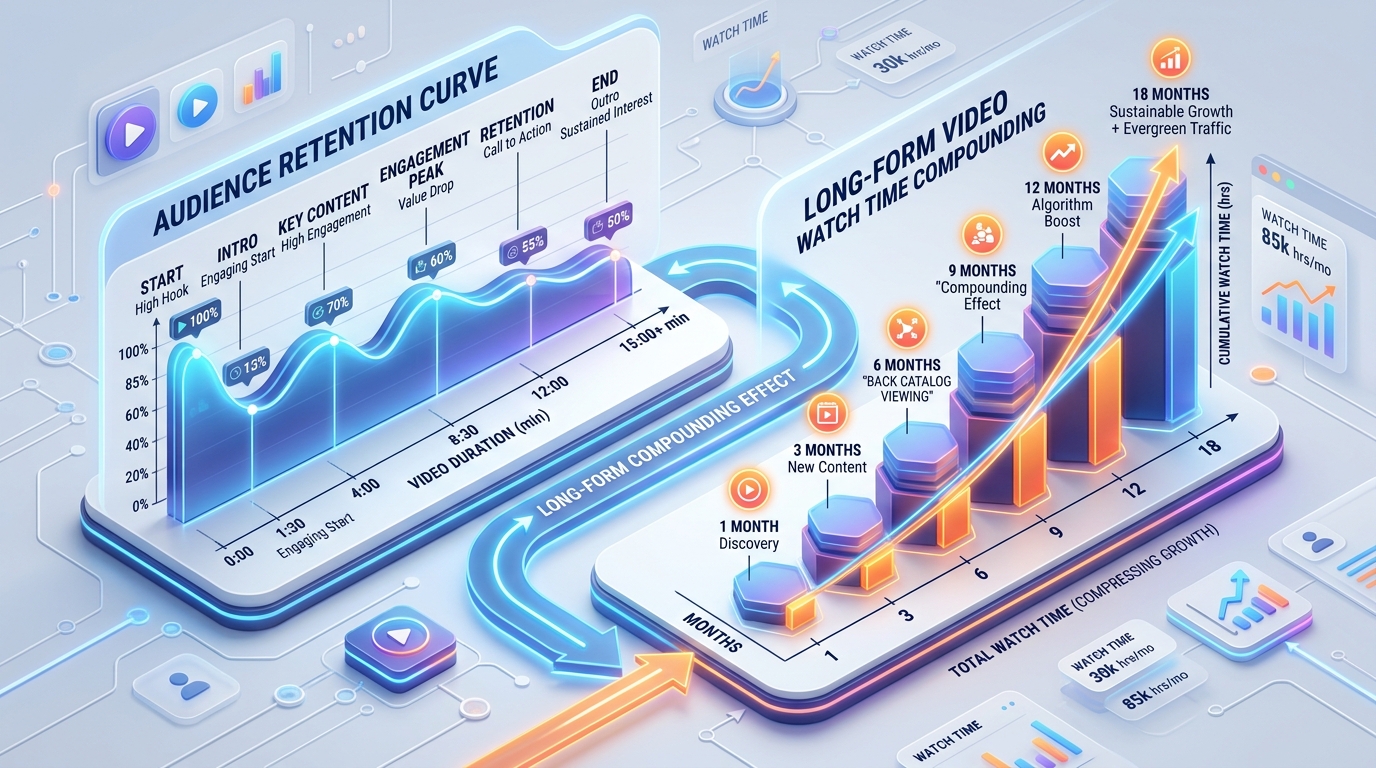
For years, outdated advice suggested that online audiences have the attention span of a goldfish, urging beginners to keep videos under five minutes. Modern analytics across billions of video impressions thoroughly debunk this myth. Long-form video is thriving on YouTube because long-form content directly satisfies YouTube’s primary corporate business metric: maximizing overall user session duration.
Consider the comparative mechanics of two contrasting channel strategies:
- Channel A (The Short-Form Trap): Publishes 5-minute videos. Achieves an impressive 60% retention rate. Average View Duration: 3.0 minutes. To reach 240,000 minutes, Channel A must generate 80,000 views.
- Channel B (The Long-Form Pillar): Publishes 16-minute videos. Achieves a moderate 45% retention rate. Average View Duration: 7.2 minutes. To reach 240,000 minutes, Channel B needs only 33,333 views.
Notice that Channel B requires less than half the total views of Channel A, despite having a lower percentage retention rate. Furthermore, YouTube’s recommendation engine heavily favors videos that accumulate large absolute quantities of watch time per impression. A video that keeps a user on YouTube for eight consecutive minutes provides more advertising inventory and session value than a video that holds a user for two minutes, earning the longer video superior placement in browse and suggested video feeds.
Structure your core tutorial and educational videos between 14 and 18 minutes. This duration is long enough to provide exhaustive, high-retention value that accumulates massive watch time, yet tight enough to prevent unnecessary fluff and pacing drag that causes audience fatigue.
To sustain audience engagement over a 15-minute runtime, your script must be structured with cyclical narrative pacing. Every three to four minutes, introduce a micro-revelation, a visual shift, or a counter-intuitive case study. If your visual framing remains static for twelve continuous minutes, visual boredom triggers passive drop-off regardless of how articulate your speech is.
3. Engineering High-Retention Hooks: Surviving the Critical First 30 Seconds
Every second of watch time you desire in minute fifteen is completely contingent upon surviving the brutal filter of minute zero. YouTube Studio retention graphs consistently reveal that the steepest drop-off in audience attention occurs within the first 30 seconds of playback. On average, amateur videos shed between 35% and 55% of their audience before the 45-second mark.
To plug this massive retention leak, you must completely eliminate the three traditional intro sins that plague beginner channels:
- The Animated Logo Intro: Nobody on the internet cares about an eight-second spinning 3D channel logo with royalty-free dubstep music. It provides zero value, wastes time, and signals that the video was produced by an amateur. Delete your animated intro permanently.
- The Rambling Personal Monologue: Phrases like “Hey guys, welcome back to the channel, sorry I haven’t uploaded in two weeks, I’ve been really busy with work, but today we have an awesome video…” cause immediate clickaways. Viewers clicked for the solution promised in the thumbnail, not your personal scheduling excuses.
- Premature Subscription Begging: Asking viewers to like, subscribe, and ring the notification bell before you have delivered a single second of valuable insight is insulting. Viewers subscribe after they receive value, never before.
Instead, implement the Needle Hook Formula: within the first five seconds, state the exact problem you are going to solve, show visual proof of the finished result, and preview the single biggest secret you will reveal in step three. By validating the thumbnail promise immediately, you lower cognitive anxiety and give the viewer a compelling psychological reason to stay locked into the video.
Analyze how top documentary essayists structure their introductions. Within the first eight frames, a high-stakes question is posed or an intriguing visual anomaly is highlighted. The presenter does not introduce themselves until the two-minute mark, after the narrative tension has been established so firmly that the viewer is physically incapable of looking away. Adopting this television-grade opening structure will immediately boost your 30-second retention from 45% to over 72%.
4. Evergreen Search Traps vs. Viral Spikes: Building Compounding Assets
Creators attempting to reach 4,000 watch hours often look at viral browse features with envy, attempting to jump on fleeting celebrity controversies, trending pop songs, or meme formats. While a viral video can generate a sudden surge of views, trending traffic suffers from catastrophic decay. A trending video that gets 10,000 views in 48 hours will often drop to less than ten views per day by week three.
If you rely exclusively on browse traffic, you are trapped in a fragile cycle where missing an upload causes your watch time accumulation to halt. To cross 4,000 hours with certainty, your foundational content library must be constructed on Evergreen Search Intent.
| Topic Focus | Query Example | Longevity Lifespan | Watch Time Contribution |
|---|---|---|---|
| Troubleshooting & Fixes | “How to Fix Audio Delay in OBS Studio” | 3 to 5 Years | Steady 50–150 minutes/day indefinitely |
| Zero-to-One Tool Tutorials | “DaVinci Resolve Full Beginner Editing Course” | 2 to 4 Years | Massive 200–500 minutes/day compounding |
| Hardware Setup & Calibration | “How to Connect Shure SM7B to Focusrite Scarlett” | 3+ Years | High-intent 80–120 minutes/day |
| Trending News / Commentary | “New YouTube Policy Drama Breakdown” | 3 to 7 Days | Brief burst followed by zero residual watch time |
Evergreen utility videos act as miniature digital real estate properties. When someone experiences a software bug, purchases new hardware, or decides to learn a creative skill, they actively search YouTube with high intent and patience. These searchers are not casual swipers; they are problem-solvers who sit through twelve-minute explanations with high focus, driving extraordinary retention rates that accumulate watch hours 24 hours a day, 365 days a year.
When engineering evergreen topics, perform keyword validation through incognito search auto-complete. When typing your primary software or hardware query, observe the exact phrases suggested by YouTube’s algorithm. These suggestions are not random guesses; they are real-time aggregations of high-volume search queries that lack authoritative video answers. If you produce a definitive, high-definition tutorial that solves that precise question with timestamped chapters, your video will establish an unshakeable ranking at the top of search results for years.
5. The Playlist Chaining Protocol: Multiplying Session Watch Time
One of the most powerful and underutilized mechanisms for accelerating watch hours is Session Watch Time Multiplication. When a viewer discovers your channel through search, watches one video, and exits, you earn a single unit of watch time. However, if that same viewer immediately transitions into a second and third video from your channel, YouTube’s recommendation system registers a profound signal of channel authority.
YouTube’s algorithm does not evaluate videos in isolation; it measures how effectively a video initiates or contributes to an extended viewing session. When a video consistently leads viewers into consuming subsequent videos on your channel, YouTube prioritizes that video across browse and suggested feeds.
Never create generic playlists labeled “My Videos” or “Uploads”. Instead, engineer Progressive Curriculum Playlists consisting of 4 to 6 tightly sequenced episodes (e.g., “The 0 to 10k YouTube Studio Build Blueprint”). At the conclusion of Episode 1, do not say goodbye; use our Seamless Audio Bridging technique to state: “Now that your studio lighting is dialed in, your audio will ruin your video if you don’t calibrate your microphone. Click right here to watch Episode 2.”
To maximize the technical efficacy of this strategy, configure your playlist settings in YouTube Studio as an Official Series Playlist. This signals to YouTube that the videos within the playlist belong to a chronological sequence. When a viewer watches an episode on mobile or desktop, YouTube automatically queues the subsequent episode as the primary “Up Next” recommendation, effectively locking competitor videos out of the sidebar and keeping the viewer immersed exclusively inside your content ecosystem.
6. Long-Form Live Streaming: The Fast-Track Accelerator
If your channel is sitting at 1,500 watch hours and you need a reliable method to bridge the remaining gap rapidly, Live Streaming is the single fastest tactical lever available. While producing an edited 15-minute video requires ten to twenty hours of scripting, filming, and post-production, a two-hour interactive live stream generates massive watch time in a single afternoon.
Consider the live streaming watch time equation:
- If you host a 2-hour live stream (e.g., Live Q&A, Portfolio Review, Live Software Troubleshooting, or Interactive Build).
- If you maintain an average concurrent audience of just 35 viewers throughout the 120-minute broadcast.
- 35 viewers × 120 minutes = 4,200 minutes of watch time (which equals 70 full watch hours) generated in just two hours!
Executing two well-promoted live streams per month alongside your regular weekly uploads can easily inject 150 to 300 additional watch hours into your monthly total. Crucially, as long as the live stream replay is archived as a Public Video on your channel, every view generated by users watching the replay continues to count toward your official 4,000-hour monetization requirement.
To ensure high attendance during live broadcasts, publish a YouTube Community Tab poll three days prior asking your subscribers which specific problem or workflow they want broken down live. When your audience feels co-ownership of the live broadcast agenda, attendance rates increase by over 200%, establishing high concurrent viewer counts right from the opening minute.
7. Community Tab and Shorts Funneling: Directing Traffic to Long-Form
A common misconception among beginner creators is assuming that YouTube Shorts watch time counts toward the 4,000-hour threshold. It does not. Watch time generated from vertical videos viewed in the Shorts feed counts exclusively toward the alternate 10 million Shorts views criteria. However, savvy creators use Shorts and Community Tab updates as high-velocity top-of-funnel discovery magnets to feed viewers directly into long-form watch time pillars.
When you publish a 16-minute in-depth tutorial, extract the single most exciting 45-second tip and format it as a vertical YouTube Short. In the Short, provide immediate value, and then use YouTube’s official “Related Video” linking feature (available inside YouTube Studio) to anchor the Short directly to your full 16-minute long-form tutorial. Viewers who discover your concise tip on mobile can tap the clean one-click link to immediately launch into the complete long-form video, transforming casual short-form scrollers into dedicated long-form watch time accumulators.
Additionally, leverage high-engagement Community Tab image polls between video uploads. Community polls are actively distributed by YouTube’s feed algorithms to users who recently watched your videos, even if they have not yet subscribed. Include a link to your latest long-form pillar in the poll commentary, re-activating dormant viewers and channeling them back into your high-retention video library.
8. What NOT to Do: Black Hat Traps That Trigger Channel Bans
Desperation to hit the 4,000-hour milestone often leads creators into the hands of predatory services promising “Instant Monetization” for $150. Falling for these black-hat traps is the fastest way to permanently destroy your channel’s future:
• Watch Time Farms & Bot Traffic: Services that use virtual machine farms to play your videos on loop generate synthetic watch time that YouTube’s fraud detection models easily identify. Not only are these hours stripped from your analytics, but your channel will receive a permanent strike for fake engagement.
• Looping on Personal Devices: Playing your own videos on loop from multiple browser tabs or household Wi-Fi networks will be filtered out by YouTube’s IP clustering algorithms as invalid traffic.
• Sub4Sub and Engagement Pods: Begging people in Facebook groups or Discord servers to watch your video creates catastrophic retention damage. These users click, leave the tab open in the background, or close it after 20 seconds, dragging your Average Percentage Viewed down to 10% and killing your organic algorithmic velocity.
9. Advanced Technical SEO & Audience Demographic Tuning
Achieving 4,000 watch hours rapidly requires understanding how YouTube’s search and discovery infrastructure indexes video semantic tokens. When your video is uploaded, YouTube’s automated transcription engine creates a word-by-word timestamped transcript. This text is fed directly into natural language processing (NLP) neural models to classify your video’s exact topical entities.
To maximize indexing precision and capture search impressions from high-intent viewers:
- Vocalize Your Core Keywords Naturally: State your primary focus keyword and related technical terms clearly within your spoken dialogue during the first two minutes. Because YouTube parses automated closed captions, vocalizing search phrases provides unassailable topical confirmation.
- Structure Granular Timestamped Chapters: As outlined in our technical SEO blueprints, formatting timestamp markers beginning at
00:00with descriptive labels generates interactive key moments in Google search results. Viewers searching for specific micro-solutions on Google are directed directly to that exact second of your video, capturing targeted external traffic that adds compound watch time. - Target High-Watch-Time Demographics: Viewers on desktop computers and connected Smart TVs consistently watch videos for longer consecutive durations than mobile users browsing on noisy subway commutes. Educational, coding, hardware calibration, and long-form video essay topics naturally attract high desktop and living-room television viewership, multiplying your average view duration by up to 300%.
10. The 30-Day Watch Time Sprint: Weekly Action Blueprint
To turn these strategic principles into an actionable operational roadmap, execute this structured four-week sprint designed to generate your first 1,000 to 1,500 legitimate watch hours in thirty days:
Week 1: Foundational Search Pillar
• Research high-intent software or hardware troubleshooting queries using incognito auto-suggest.
• Script and record one comprehensive 18-minute masterclass solving the problem completely.
• Package with a high-contrast thumbnail tested against dark mode interfaces (#0F0F0F).
Week 2: The Curriculum Chaining Video
• Produce Episode 2 that directly answers the logical next question raised in Week 1.
• Group both uploads into an Official Series Playlist and implement Seamless Audio Bridging.
• Pin a strategic comment linking directly to the playlist in Episode 1.
Week 3: The Interactive Live Stream Event
• Announce a live Q&A or interactive walkthrough via Community Tab poll.
• Broadcast for 90 to 120 minutes with low latency and automated audio ducking.
• Archive the stream immediately as a public video with customized thumbnail and chapters.
Week 4: The Discovery Shorts & Back-Catalog Audit
• Cut two 45-second high-value vertical Shorts from your Week 1 and Week 2 pillars.
• Attach official Related Video links pointing mobile scrollers into your full tutorials.
• Audit older video thumbnails with low CTRs (<3%) and test bold, high-contrast replacements.
Frequently Asked Questions
No. Only watch hours accumulated while a video is set to Public count toward the 4,000-hour requirement. If you set a video to Unlisted, Private, or delete it from your channel, all watch time previously generated by that video is immediately deducted from your monetization eligibility meter.
YouTube’s 365-day rule is a rolling window, not a hard annual deadline. It calculates the total valid watch hours earned in the past 365 consecutive days from today. You do not reset to zero on January 1st; only the watch hours earned on the day exactly 366 days ago fall off the calculation.
No. Watch time generated by viewers watching vertical Shorts in the Shorts Feed does NOT count toward the 4,000 long-form watch hours. Shorts views count strictly toward the alternative monetization requirement of 10 million Shorts views in 90 days.
No. Views and watch time generated through paid Google Ads campaigns (discovery ads or in-stream ads) are explicitly excluded from the 4,000 public watch hours needed for YouTube Partner Program qualification.
For channels focusing on search-optimized, high-retention long-form content (12 to 18 minutes), most creators achieve 4,000 watch hours with a library of between 25 and 45 well-produced videos. Consistent weekly publishing accelerates this timeline to 6 to 9 months.